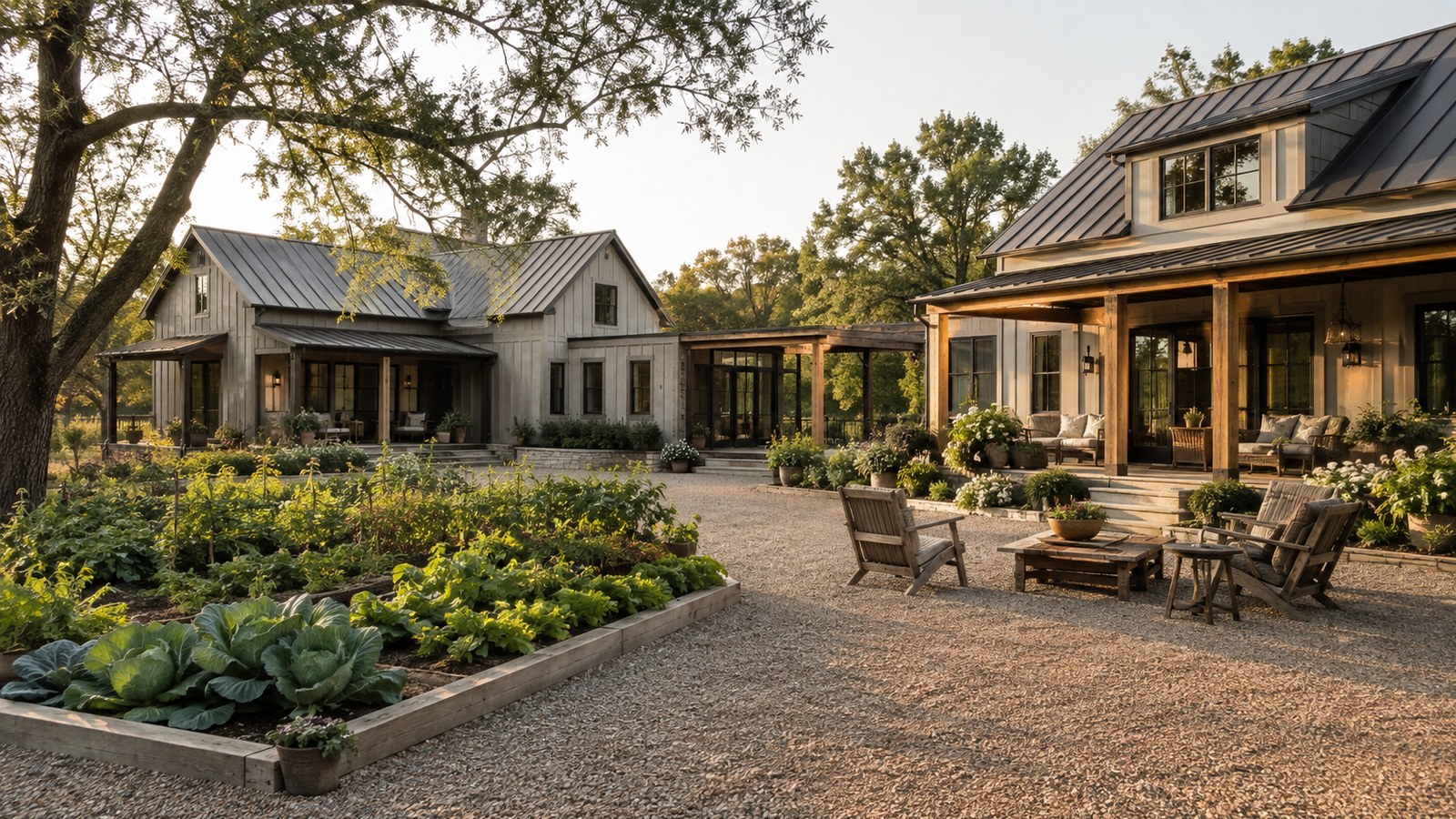
Choose a Shared-Living Arrangement Before Choosing the Acreage
Two households can share country land in very different ways: behind separate doors in one building, in a main house and smaller dwelling, or in homes with their own parcels and a shared outdoor resource. Those arrangements change how people meet, make decisions, pay for repairs, and eventually leave. The right choice depends less on an impressive acreage total than on the independence each household needs and the responsibilities everyone is prepared to share. This guide compares practical property forms and their everyday tradeoffs. These are configurations to investigate, rather than a ranking of current listings or a statement that every form is permitted everywhere. Use them to establish a clear brief before a property search, then have the actual units, ownership, services, and intended uses checked for any candidate you take seriously.
A Duplex Can Keep Shared Living Compact
A duplex puts two independent homes within one building. For related households that want proximity without a shared kitchen, this can make contact convenient while maintaining separate daily routines. A compact footprint may also leave more of the parcel available for a garden or other agreed activities. The building needs genuine functional separation, including appropriate entrances and the residential facilities and approvals for each unit.
Its main tradeoff is that physical closeness continues when people want quiet. Sound transmission, adjacent terraces, bedroom locations, and parking routes deserve particular attention. A duplex with entrances on different sides may feel more independent than one with front doors beside a shared sitting area. Neither arrangement removes responsibility for common structural elements, so establish how roofs, exterior repairs, and any shared services will be funded and managed.
A Main House and ADU Suit Unequal Space Needs
A main house with an accessory dwelling unit can work when the households want different amounts of living space. An older parent may prefer a smaller home near family; another arrangement might pair an owner-occupied main house with a permitted rental. The American Planning Association describes an ADU as a smaller independent residential unit associated with a principal home. That relationship is important: a smaller dwelling on the same property should not be assumed to have separate ownership or unrestricted occupancy rights. Check the local classification and approvals, and discuss how unequal space, financial contributions, and control will be handled before treating this as an equal partnership.
Two Detached Homes Offer Separation With More Infrastructure
Separate houses can provide a clear sense of home for each household. Residents can have distinct entrances, outdoor rooms, work schedules, and visitors without sharing a wall. Positioning the homes around a common garden can support regular contact while allowing each to turn toward its own private space. The site plan should make these choices legible rather than leave future occupants to negotiate an ambiguous strip of lawn.
The same separation can increase the amount of property to maintain. Two roofs, heating systems, access routes, and sets of exterior components may require different contractors and replacement schedules. Distance between buildings can add service runs or create awkward shared-system dependencies. Compare the finished operating arrangement with the closer forms, including the time needed to look after it.
Confirm that both homes are authorized for the intended use. A listing describing a guest cottage or second residence does not settle its legal status, occupancy conditions, or the possibility of separate sale. If the ownership is shared, obtain advice on the actual title and agreements. Separate buildings can feel autonomous while remaining inseparable financially and legally.
A Small Cluster Can Share Space Deliberately
Several modest dwellings grouped around a shared space can appeal to households seeking community without one large shared interior. A common garden, workshop, or covered gathering area may provide the reason to live together, while the homes retain essential private facilities. Design the cluster around the activities residents want to share and the routes they will actually use. A central space that everyone must cross to reach a front door may encourage encounters but leave little choice about participation.
More households also mean more decisions about guests, noise, pets, equipment, spending, and maintenance. Establish whether the arrangement is an existing approved development or a proposed project requiring substantial planning work. New clusters can involve complicated land-use, infrastructure, financing, and ownership decisions. Do not compare an undeveloped idea with a finished duplex as though their time, cost, and uncertainty were equivalent.
Separate Parcels Can Preserve an Individual Exit
Homes on separately owned parcels may suit people who want to live near one another while retaining clearer individual control over their own houses. A shared road, garden, or other amenity can still connect them, subject to the relevant rights and agreements. Separate title does not remove every dependency: access, drainage, wells, or restrictive covenants can link the properties. Have those connections reviewed, including maintenance and payment obligations, and verify that any proposed parcel division is actually possible before assigning value to it.
Decide What Must Be Private
Start with the spaces that each household needs to control independently. Sleeping rooms, bathrooms, food preparation, working from home, and a place to sit outside may carry different importance for different residents. Discuss those preferences directly instead of assuming that relatives or friends want the same degree of contact. A household that loves shared evening meals may still need a private entrance and somewhere to receive visitors.
Then consider boundaries between private and shared areas. A path can communicate a change of territory more clearly than an informal understanding about a lawn. Storage, laundry, garden tools, and parking often become sources of friction because they seem too minor to discuss during the purchase. Give them places and responsibilities before judging the arrangement by its most attractive communal feature.
Choose proximity with care if the arrangement is intended to support assistance. A detached home reached by a long uneven path may make spontaneous contact less comfortable than an attached unit. Conversely, a shared doorway can make it hard for a person to feel independent. Ask the intended residents to test the actual route and explain what they want help with, rather than letting a generalized idea of family living determine the plan.
Match Shared Activities to Willing Workers
A large vegetable garden, paddock, orchard, or woodland can make shared country living appealing. Each also brings work that persists when a resident is busy, ill, away, or no longer interested. Identify the proposed activity, its likely tasks, and the people who genuinely want responsibility for it. Sharing the benefits is different from having an agreed plan for planting, mowing, repairs, equipment, and waste.
Separate routine tasks from occasional spending decisions. Residents might rotate a modest garden job while hiring a contractor for dangerous or specialist work. Set a process for approving purchases and for deciding when a voluntary activity has become too demanding. The property will be easier to manage if shared ambitions can change without turning one household into the permanent caretaker for everyone else.
Make the Financial Arrangement Understandable
Agree how the purchase, ongoing costs, and major improvements will be funded, and have the proposed ownership and borrowing structure reviewed professionally. A private agreement to split a payment does not necessarily limit what a lender can require under the loan documents. The Consumer Financial Protection Bureau explains that a co-borrower shares responsibility for repaying the mortgage. Discuss liability, missed payments, and the difference between an ownership share and debt responsibility before anyone commits money.
Put Decisions and Disagreements on Paper
A useful shared-property agreement addresses ordinary operations as well as difficult events. Discuss who can authorize an urgent repair, how a larger improvement is approved, and what happens when households disagree about spending. Include how payments and work will be recorded. Obtain advice appropriate to the ownership form and jurisdiction so that the document matches the property rather than a generic online example.
Plan an exit while everyone is enthusiastic. A resident may need to relocate, change household size, sell an interest, or recover money contributed to improvements. Discuss valuation, timing, buyout procedures, and what happens if the others cannot afford to buy. Agreements should also address relevant death, incapacity, and dispute scenarios with professional assistance; affection and good intentions do not resolve the practical consequences by themselves.
Review the arrangement periodically after moving in. Circumstances change, and an informal adjustment to the garden schedule may be harmless while a new long-term occupant or financial contribution needs formal attention. Keep meaningful changes consistent with approvals, loan and insurance terms, and the governing documents. The aim is to make expectations visible, not to require a meeting about every ordinary household choice.
Compare Two Realistic Household Briefs
Consider an illustrative family in which one household wants a larger home and the other wants modest accommodation close to support. A main house and approved ADU might match that unequal space requirement better than buying two equally large houses. The key checks would include the smaller resident's daily route, privacy, occupancy rights, and the consequences of a future change in care needs. This is a planning example, not an account of a particular family's purchase or a claim about the cheapest option.
Now consider two unrelated households contributing similar amounts and expecting similar independence. A duplex with well-separated entrances or separately owned neighboring homes might offer a clearer fit than a main-house-and-cottage arrangement controlled by one owner. They would still need to establish service responsibilities, borrowing, decision rules, and an exit route. Comparing the same household brief across several forms exposes differences that an acreage-based search can conceal.
Give Every Household a Voice in the Viewing
Before visiting a candidate property, ask each household to identify one ordinary routine that must work there and one compromise it would find difficult. During the viewing, separate briefly so that each can assess its proposed rooms and entrance without the group's enthusiasm setting the answer. Rejoin to walk the shared areas and compare observations about noise, storage, movement, and outdoor use. Record unresolved differences alongside physical defects and missing documents; they are relevant to whether this property suits the arrangement. For example, a household expecting daily use of a workshop may see a distant outbuilding as a major benefit, while another may mainly see the drive they would be asked to maintain. Neither reaction is a defect in the people involved. The decision becomes more reliable when the benefit, cost, and responsibility are all made explicit before an offer.
Test the Arrangement Before Starting the Search
Write down the minimum private accommodation for each household, the activities to share, the work people will undertake, and the commitments they can afford. Include an acceptable travel area and the services residents need. Use that brief to eliminate configurations that cannot meet the basics, even if the photographs are appealing. A shared property becomes a stronger prospect when its form supports the relationships and responsibilities you have actually agreed to.
For any shortlisted home, move from the configuration comparison to a property-specific investigation. Confirm the units, inspect the buildings and systems, review title and agreements, and establish finance and insurance on the intended basis. Keep unresolved issues explicit until the appropriate people have answered them. Choosing shared country living should mean choosing a workable arrangement between households as carefully as choosing the land around them.